Heavy-duty, factory-engineered strength equipment verified for high-traffic commercial deployment

Singapore's commercial fitness ecosystem represents one of Asia's most sophisticated and high-density markets. With real estate overheads in prime commercial districts such as Raffles Place, Tanjong Pagar, and Orchard Road commands premium pricing per square foot, gym owners, facility operators, and institutional buyers must maximize structural spatial efficiency without sacrificing safety or equipment durability.
Navigating the procurement of commercial gym rigs, power cages, custom matrix stations, and functional fitness rigs requires a thorough understanding of metallurgical integrity, tropical environmental factors, and strict compliance with local building codes. Facilities serving Singapore operate under continuous high-throughput demands—from 24-hour commercial chains to boutique Functional Threshold Power (FTP) studios, corporate wellness centers, and educational weight rooms.
This technical whitepaper provides commercial gym operators, project managers, and procurement officers in Singapore with an authoritative guide to sourcing commercial gym rigs directly from tier-1 global manufacturing facilities. By evaluating raw material standards, surface treatment engineering, structural installation physics, and total cost of ownership (TCO), operators can secure significant Information Gain and structural advantages over competitors using light-duty retail equipment.
Not all gym rigs are engineered equally. When procuring rig systems for commercial facilities in Singapore, structural failure or excessive frame deflection is a severe liability. Tier-1 commercial manufacturing demands rigorous material selection and robotic fabrication techniques.
Commercial rigs must utilize 3in x 3in (75mm x 75mm) or 2in x 3in upright posts constructed from 11-gauge (approx. 3.0mm wall thickness) structural Q235B or Q355 steel. Inferior 14-gauge (2.0mm) steel widely used in retail rigs yields under dynamic drop-loads, leading to micro-fractures in welded joints over extended heavy use.
Singapore’s relative humidity averages 84% annually. Standard liquid paint fails rapidly under sweat immersion and tropical humidity, causing sub-surface oxidation. Direct factory suppliers apply a multi-stage process: automated shot-blasting, zinc-phosphate pre-treatment, and dual-layer electrostatic thermosetting powder coat baked at 220°C.
Uniformity in hole spacing is critical for safety attachments such as J-hooks, spotter arms, and dip bars. Advanced factories employ 3D CNC fiber laser cutters ensuring pitch accuracy within ±0.05mm, featuring Westside 1-inch hole spacing through the bench press zone for customized biometric positioning.
When reviewing factory technical data sheets (TDS) during Singapore procurement tenders, insistence on the following thresholds is paramount:
| Engineering Parameter | Tier-1 Commercial Factory Spec | Standard Commercial Spec | Light Commercial / Retail Spec |
|---|---|---|---|
| Upright Steel Gauge | 11-Gauge (3.0mm - 3.25mm) Q355 Steel | 11-Gauge (2.75mm - 3.0mm) Q235 | 14-Gauge to 16-Gauge (1.5mm - 2.0mm) |
| Frame Tube Profile | 75mm x 75mm (3" x 3") / 80mm x 80mm | 75mm x 75mm (3" x 3") | 50mm x 50mm (2" x 2") |
| Welding Process | Full-Surround Robotic MIG Welding | Manual MIG Seamless Welding | Spot TIG / Partial Bead Welding |
| Corrosion Resistance | 1000+ Hours ASTM B117 Salt Spray Test | 500 Hours Salt Spray Test | Standard Single Coat Paint (< 100 Hours) |
| Hardware & Fasteners | Grade 8.8 / Grade 10.9 Zinc Coated Bolts | Grade 8.8 Hex Bolts | Grade 4.8 Standard Hardware |
| Static Weight Capacity | 1,500 KG (3,300 lbs) per bay | 1,000 KG (2,200 lbs) per bay | 350 KG (770 lbs) total capacity |
Architecture in Singapore presents unique structural constraints. Sourcing modular, custom-configurable gym rigs allows operators to navigate low ceiling heights in heritage shophouses, high-rise slab loading restrictions, and multi-functional space requirements.
Structural Challenges: Constrained ceiling heights (often under 2.7 meters), timber joist ceilings preventing top-anchoring, narrow floor footprints (4 to 6 meters wide).
Rig Architectural Solution: Low-profile wall-mounted folding rigs or self-supporting 2.4-meter custom uprights. Rig depth is restricted to 24 inches from the wall, incorporating pull-up bars adjusted to precise timber beam clearances. Footplates utilize spreaders to distribute point loads across historic floors.
Structural Challenges: Building and Construction Authority (BCA) floor loading rules (typically 4.0 to 5.0 kN/m²), prohibition of invasive floor drilling into tensioned concrete slabs, strict acoustic/vibration insulation standards (Acoustic Transmissibility).
Rig Architectural Solution: Free-standing island rig matrices integrated with heavy-duty structural base frames. Rigs feature integrated rubber isolation feet and weight-plate storage wings that eliminate the need for concrete floor anchors, distributing kinetic load safely within BCA structural limits.
Structural Challenges: Unsupervised high-frequency usage, broad demographic variations (youth to seniors), stringent maintenance oversight by Management Corporation Strata Title (MCST) boards.
Rig Architectural Solution: Multi-station selectorized hybrid rigs combining pin-loaded cable stations (pulley columns, lat pulldowns) with guided Smith attachments and tamper-proof J-cups. Focus is placed on enclosed weight stacks and smooth biomechanics to minimize user error and injury risks.
Structural Challenges: High-density athlete movement, rapid transitions between barbells, gymnastics rings, landmines, and wall-balls, requirement for maximal open floor space.
Rig Architectural Solution: Continuous wall-mounted or center-stage bridge rigs spanning 10 to 20 meters. Equipped with integrated target plates, heavy-bag hangers, monkey bars, and vertical storage pegs for bumper plates, freeing up floor space for sled turf tracks.
When installing floor-anchored rigs in Singapore commercial properties, anchor bolts must avoid damaging post-tensioned cables embedded within concrete slabs. Factory-supplied structural layout drawings (2D CAD & 3D BIM models) allow local structural engineers (PE) to verify anchoring points against building floor structural plans prior to installation.
As Singapore continues to solidify its status as a regional health and wellness hub, commercial gym design is undergoing rapid structural evolution. Operators sourcing rigs today must plan for tomorrow's facility demands.
Functional endurance training has transformed Singapore's gym market. Commercial facilities are replacing single-purpose selectorized line space with versatile rig hubs capable of accommodating squatting, pull-ups, ring dips, resistance bands, and wall-ball stations within a single unified footprint.
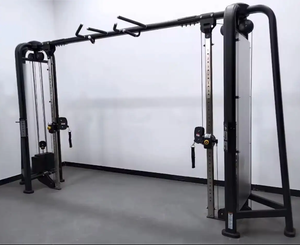
Space efficiency demands multi-functionality. Modern suppliers offer custom rigs that integrate pin-loaded dual adjustable pulley (DAP) cable stacks directly onto 3"x3" rig upright posts. This hybrid approach provides member-driven cable training without consuming standalone floor space.
Singapore's boutique gym market is highly visual and brand-centric. Factory direct suppliers now offer custom laser-cut brand logos on structural crossmembers, paired with bespoke RAL color powder coatings (matte black, gunmetal gray, military green, and brand-matched accents) to enhance visual marketing appeal.
Procurement managers face a classic trade-off: buying from local Singapore stocking distributors or sourcing directly from primary manufacturing facilities in China. Below is a strategic comparison outlining cost, customization, and quality control metrics.
| Evaluation Criteria | Direct Factory OEM Sourcing (Recommended) | Local Singapore Distributor / Reseller |
|---|---|---|
| Capital Expenditure (CAPEX) | 30% - 50% Lower: Direct factory pricing eliminates middleman markups and importer margins. | High Markup: Includes local warehouse holding costs, distributor profit margins, and reseller fees. |
| Customization Flexibility | Unlimited: Custom frame dimensions, colorways, hole spacing, and integrated brand laser-cutting. | Restricted: Limited to pre-imported stock colors, standard heights, and fixed modular setups. |
| Quality Control & Traceability | Direct Inspection: Access to mill test certificates (MTC), raw steel batches, and factory FAT testing. | Indirect: Relies on distributor claims with minimal visibility into raw material provenance. |
| Lead Time to Singapore | 18 - 25 Days: Production (10-15 days) + Direct Sea Freight via PSA Singapore (5-7 days). | 1 - 3 Days (If In-Stock): Fast delivery for standard items, but months if backordered. |
| Spare Parts & Long-Term Support | Guaranteed Factory Parts: Direct access to exact replacement attachments, J-cups, cables, and posts. | Variable: Dependent on whether the distributor maintains long-term brand representation. |
With over two decades of heavy-duty commercial equipment manufacturing expertise, our state-of-the-art production facilities deliver world-class gym rigs, strength training systems, and precision selectorized machinery to commercial gyms, universities, and military facilities across Singapore and worldwide.
From 2D spatial layouts and 3D rendering to custom structural engineering and mass fabrication, we provide turnkey equipment solutions tailored specifically to Singapore floor plans.
Every frame undergo strict Quality Assurance: ultrasonic weld testing, surface coating thickness checks (minimum 120 microns), and structural load testing before export packaging.
We handle export customs, ISPM-15 compliant wood crate packaging, ocean freight to Singapore PSA port, and direct DDP (Delivered Duty Paid) coordination including 9% GST handling.
Our commercial rigs come backed with a 10-Year Structural Frame Warranty, ensuring your investment is protected against manufacturing defects and structural failures.
Essential technical and operational insights for commercial gym buyers, project engineers, and facility owners in Singapore.
Sea freight from our factory to the Port of Singapore (PSA) typically takes 5 to 7 days in transit. Total lead time—including custom CNC laser manufacturing, powder coating, export clearance, ocean transit, and Singapore local delivery—is generally 21 to 28 calendar days. Express air freight is available for smaller replacement parts or accessories.
We offer DDP (Delivered Duty Paid) shipping terms for Singapore clients. Our logistics partners handle Singapore Customs declarations, permit applications via TradeNet, and payment of the applicable Singapore GST (9%), delivering equipment directly to your site hassle-free.
Yes. We routinely manufacture custom upright posts engineered specifically for low-clearance spaces (e.g., 2.2m to 2.5m heights). All structural hole spacing, crossmember positions, and pull-up bar heights are adjusted during factory laser-cutting to ensure full functionality without ceiling interference.
For solid concrete floors, we supply heavy-duty M12/M16 expansion anchor bolts or chemical anchors. In locations where floor drilling is prohibited by building management (MCST or mall operators), we engineer self-supporting free-standing base frames with stabilizing crossmember feet and weight plate storage wings that do not require floor anchors.
Our equipment undergoes automated shot-blasting, chemical degreasing, zinc-phosphate anti-rust pre-treatment, and a dual-layer electrostatic powder coating process. This surface finish has passed 1,000+ hours of ASTM B117 salt spray testing, guaranteeing exceptional rust and corrosion resistance in humid tropical climates.
We supply full technical dossiers including 2D CAD architectural placement drawings, 3D BIM models, steel material mill certificates (MTC Q235B/Q355), finite element analysis (FEA) load reports, and static load test documentation to support your appointed Professional Engineer (PE) submissions.