Choosing commercial strength equipment is not simply a matter of comparing prices, brands, or polished showroom photographs. It is a decision about safety, member behavior, maintenance, and long-term revenue. The 2024 ACSM Worldwide Survey ranked traditional strength training fifth among global fitness trends. That result signals sustained demand for racks, cable systems, selectorized machines, benches, and free weights. However, popularity alone does not justify every purchase. A crowded room can expose poor equipment choices quickly.
The Health & Fitness Association’s 2024 Global Report also shows a large, competitive fitness market, with membership and facility investment continuing across major regions. In this environment, equipment must support different body sizes, training abilities, and workout goals. Dr. Wayne Westcott, a respected strength-training researcher, describes strength training as “a key to maintaining functional independence.” His point matters for equipment buyers. A stable bench, clear adjustment points, and controlled resistance can affect confidence as much as performance. Small details matter.
A practical selection process should examine frame durability, upholstery, cable travel, weight-stack increments, spare-part access, and floor-space efficiency. Watch real users test the equipment. Observe a beginner adjusting a seat while the room is busy. Listen for metal impact, cable friction, and awkward movement paths. No formula is perfect. A spreadsheet cannot predict every shoulder, grip, or rushed evening session. That is where many buying plans fail. The right commercial strength equipment balances biomechanics, traffic flow, service support, and measurable business value. This guide explains how to assess those factors before signing a purchase order.
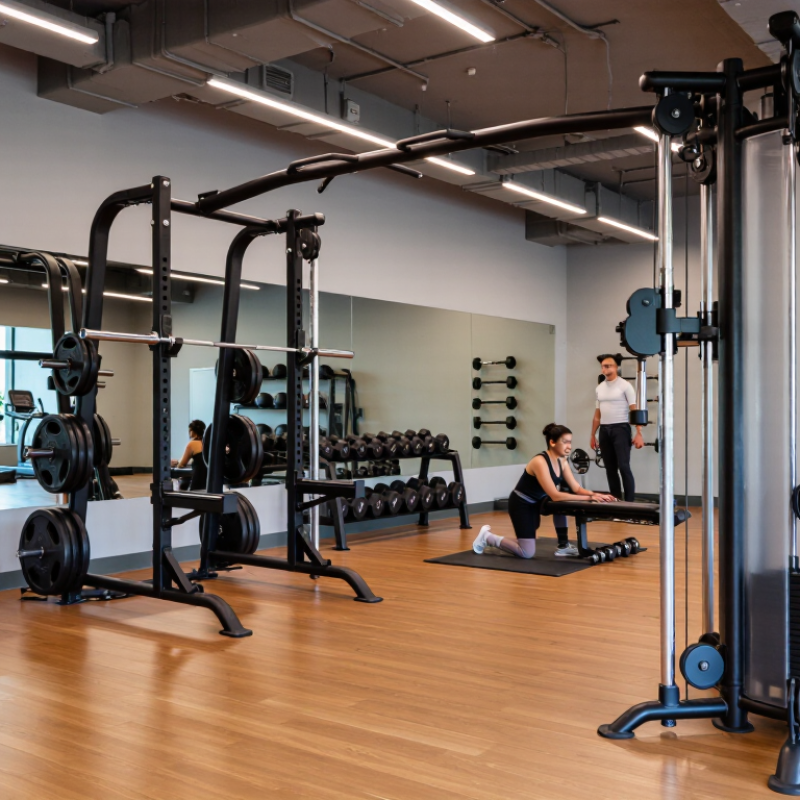
Commercial-grade strength equipment is built for repeated use, not just a convincing showroom appearance. Check the frame, welds, adjustment points, and moving parts. A bench should stay steady under load; a cable should travel smoothly without catching. “Commercial grade” is not one universal certification, so ask for documented load ratings, maintenance guidance, and warranty terms.
Demand is real. The American College of Sports Medicine’s 2025 Worldwide Fitness Trends survey, based on responses from more than 2,000 fitness professionals, ranked traditional strength training fifth among 45 trends. That finding does not predict your gym’s exact needs, but it supports planning for consistent strength-training use. Map likely traffic before buying: several members may need the same popular station during evening hours.
Fit matters. Measure the equipment footprint, then leave room for safe movement and access around it. Test seat adjustments and grip positions with people of different heights; small fit problems can become daily frustrations. Ask suppliers how often high-wear parts need inspection and whether replacement parts are available. A polished finish is nice. It is not proof of durability. I would also leave some budget for maintenance; gyms sometimes underestimate that cost, and I may be underestimating it too.
Before choosing commercial strength equipment, measure your gym as members experience it. Record ceiling height, column spacing, doorway width, flooring, and emergency routes. A rack may fit on paper, yet block a busy walkway when plates and benches move around it. Leave practical clearance for loading, spotting, and cleaning. Safety comes before density.
Study your members, not just your membership total. Track peak-hour attendance, training age, average height, and common goals. A beginner-heavy facility may need adjustable machines, clear instruction panels, and stable entry points. A performance-focused gym may need platforms, racks, cable stations, and heavier storage. ACSM’s Worldwide Survey of Fitness Trends 2024 ranked traditional strength training among the leading global trends. That supports strength investment, but it does not justify buying every machine.
Match equipment to actual programming. Count how many members train during the busiest 60 minutes. Then compare that demand with the number of usable stations. HFA’s 2024 Global Report recorded about 184 million fitness-facility memberships across surveyed markets, showing continued participation growth. Growth can expose weak layouts quickly. I would test a proposed floor plan with tape for one week. Watch queues, noise, and abandoned spaces. This step is unglamorous, but revealing. Some assumptions will be wrong. Review maintenance access, adjustment points, warranty terms, and staff inspection routines before ordering. A slightly smaller selection may serve more members when movement feels natural.
Comparing Equipment Types, Materials, and Durability
Commercial strength equipment faces different stresses depending on its design. Selectorized machines guide movement and suit busy training areas, but cables, pulleys, and adjustment pins need frequent inspection. Plate-loaded machines have fewer moving parts. Yet their frames and welds take repeated impact from loaded plates. Free-weight racks are versatile, though upright stability and secure J-cups matter more than polished finishes. ASTM F2276 and the ISO 20957 series provide relevant safety and testing frameworks; ask suppliers which requirements their equipment has been tested against.
Materials shape long-term upkeep. Thick-gauge steel frames generally resist flex better under heavy use, while powder-coated finishes help limit scratches and corrosion. They are not rust-proof. In damp rooms, inspect chipped coating near welds and bolt holes. Upholstery should have reinforced seams and dense foam that recovers after repeated compression. A softer pad may feel comfortable at first, then flatten quickly. That trade-off is easy to miss.
Usage data helps set realistic expectations. The IHRSA Global Report 2024 reported 72.9 million U.S. health-club members in 2023, underscoring the heavy use many facilities must plan for. This figure is not a durability test, though. Compare warranty terms, replacement-part availability, and published load ratings, then match them to your busiest hours. Keep a simple maintenance log. It may reveal wear patterns before a cable frays or a bench starts wobbling. I would still leave room for judgment: published ratings cannot predict every gym’s cleaning routine or training style.
When evaluating commercial strength equipment, inspect the details people touch every day. Check that adjustment pins lock firmly and that cables move without catching. Sit on the bench and test whether it shifts under pressure. Small movements can become irritating, or unsafe, during a busy class. Ask staff to demonstrate setup and emergency adjustments. If the instructions are unclear, that matters.
Build a maintenance plan before delivery. Record routine checks for bolts, upholstery, cables, and moving joints, with a named staff member responsible. A quick visual check each morning helps, but it does not replace scheduled servicing. Keep a simple log of faults and repairs. It may feel fussy. It also reveals recurring problems before they disrupt training. Ask what tools and replacement parts are needed, and how long common repairs usually take.
Read the warranty wording closely. Confirm which components are covered, for how long, and whether labor or transport costs are excluded. Ask how a claim is submitted and what proof of maintenance is expected. Get important answers in writing. Coverage can sound generous until exclusions appear. I would also compare the warranty period with the equipment’s expected daily use; that estimate is imperfect, but ignoring usage makes comparisons less useful.
Choosing commercial strength equipment begins with the floor plan, not the catalogue. Measure usable space after entrances, columns, storage, and emergency access are marked. Then draw circulation paths around racks, benches, and selectorized stations. Members need room to move safely, especially when carrying plates or adjusting cables.
Budget pressure encourages poor decisions. Avoid filling the room with identical machines. A balanced setup may include power racks, adjustable benches, cable stations, dumbbells, and a few targeted machines. The 2024 SFIA Topline Participation Report recorded 72.9 million U.S. fitness facility members in 2023. That figure suggests strong demand, but demand does not justify overcrowding. Capacity must match peak-hour behavior. Count likely users, not hopeful membership targets.
Spend more on frames, upholstery, bearings, and adjustment points. These areas face repeated daily stress. The 2024 ACSM Worldwide Survey of Fitness Trends keeps traditional strength training among leading industry priorities, supporting investment in versatile resistance equipment. Still, reports describe markets, not your exact room. That distinction matters. In practice, the first layout is rarely perfect. Leave several clear zones for expansion, storage, and changing training preferences. A cheaper purchase can become expensive when it blocks traffic or requires early replacement. Ask suppliers for warranty terms, maintenance schedules, load ratings, and replacement-part availability. Record those details before signing. Fresh paint cannot fix a cramped training floor.
| Equipment Type | Typical Purchase Budget (USD) | Approx. Equipment Footprint | Recommended Planning Area | Space and Budget Considerations |
|---|---|---|---|---|
| Selectorized Chest Press | $2,500–$6,000 | Approx. 4 × 5 ft | Approx. 7 × 8 ft | Compact, easy to use, and suitable for a wide range of members. Allow room for the seat adjustment and full arm movement. |
| Selectorized Lat Pulldown | $2,500–$6,500 | Approx. 4 × 5 ft | Approx. 7 × 8 ft | Check ceiling height and overhead clearance. A shared multi-station unit may cost less per exercise than buying several separate machines. |
| Dual Adjustable Pulley | $4,000–$10,000 | Approx. 4 × 3 ft | Approx. 8 × 8 ft | Offers many exercise options in one station. Include working space between the pulleys and enough room for cable movement. |
| Smith Machine | $2,000–$6,000 | Approx. 4 × 7 ft | Approx. 8 × 10 ft | Consider bar travel, plate storage, and access on both sides. Verify the floor can support the equipment and user loads. |
| Power Rack with Barbell | $1,500–$5,000 | Approx. 4 × 4 ft | Approx. 8 × 10 ft | Requires additional room for loading plates and safely using the bar. A rack can be a cost-effective choice for free-weight training. |
| Adjustable Bench | $300–$1,200 | Approx. 2 × 5 ft | Approx. 6 × 8 ft | Plan for the bench to move between stations. Budget for durable upholstery and stable adjustment hardware in a high-use gym. |
| Dumbbell Set with Rack | $2,000–$8,000 | Approx. 2 × 10 ft | Approx. 5 × 14 ft | Cost depends on the weight range and number of pairs. Keep a clear access aisle in front of the rack and account for floor loading. |
| Plate-Loaded Leg Press | $3,000–$8,000 | Approx. 5 × 8 ft | Approx. 9 × 12 ft | Large and heavy equipment can use substantial floor area. Check delivery access, installation requirements, and structural floor capacity. |
Planning guide: Prices and dimensions are indicative estimates in USD and vary by construction, capacity, configuration, shipping, and local market. Footprints are approximate; confirm manufacturer specifications and allow additional clearance for safe use, accessibility, and circulation. Keep aisles and exits unobstructed, and verify floor-load requirements before installation.
Look beyond a polished finish. Check frame stability, welds, adjustment points, and moving parts. Ask for load ratings, maintenance guidance, and warranty terms.
Measure doorways, ceiling height, columns, and flooring. Leave room for loading, spotting, cleaning, and clear walkways. A layout that fits on paper may feel cramped in use.
Consider peak-hour traffic, member experience, height, and training goals. Adjustable machines can help beginners. Racks, platforms, and cable stations may suit other programs.
Count how many members train during the busiest hour, then compare that with usable stations. Try a floor plan with tape. Queues tell stories.
Inspect cables, pulleys, and adjustment pins on selectorized machines. For plate-loaded machines, check frame stability and welds. Small issues can grow.
Thick-gauge steel can help resist frame flex. Powder coating can limit scratches and corrosion, but it is not rust-proof. Check chipped areas near welds and bolt holes.
Look for reinforced seams and dense foam that recovers after compression. A soft pad may feel pleasant at first, then flatten. Fit matters.
Keep a simple log of inspections and repairs. Ask about replacement parts and tested safety requirements. Published ratings cannot predict every gym’s use; I would question my own assumptions, too.
Choosing the right commercial strength equipment is essential for creating a safe, efficient, and profitable gym. Start by understanding what makes equipment commercial grade, including its structural strength, stability, weight capacity, and ability to withstand frequent daily use. Then assess your available space, member profiles, and primary training goals. A facility serving beginners may need accessible machines and guided movement options, while a performance-focused gym may require more racks, free-weight stations, and functional training areas.
When comparing equipment, consider frame materials, upholstery quality, adjustability, ergonomics, and long-term durability rather than focusing only on the initial price. Safety features, ease of cleaning, maintenance requirements, replacement parts, and warranty coverage should also influence your decision. Finally, create a realistic budget and arrange equipment according to your floor plan, allowing enough room for movement, supervision, and safe storage. The best commercial strength equipment balances quality, versatility, user safety, and long-term operating value.