The search for the best heavy-duty gym equipment manufacturers in China starts with a practical question: which supplier can build machines that stay stable under repeated, demanding use? Global demand gives this question real context. The Health & Fitness Association’s 2024 Global Report estimated that health clubs worldwide generated about $96.7 billion in revenue in 2023, serving roughly 184 million members. That scale points to a large market, but it does not tell buyers which factory makes the strongest rack or most reliable cable system.
Look beyond a polished catalog. A buyer should examine frame steel specifications, weld consistency, coating quality, load ratings, replacement-part availability, and documented quality-control procedures. Ask for test reports and clear warranty terms. Where possible, inspect a sample unit or arrange a factory audit. These checks help distinguish measurable capability from marketing language. They also matter in everyday details: a bench that rocks on a flat floor, a pulley that catches under load, or a finish that chips quickly can undermine an otherwise attractive purchase.
This guide compares manufacturers through product range, production experience, customization, certifications, export support, and after-sales service. Company claims should be checked against records and physical evidence. That takes time. Industry reports describe market scale, not factory performance, so no single ranking can replace buyer due diligence. The comparison is a starting point, not a guarantee; even strong suppliers may have uneven models or service in particular regions.
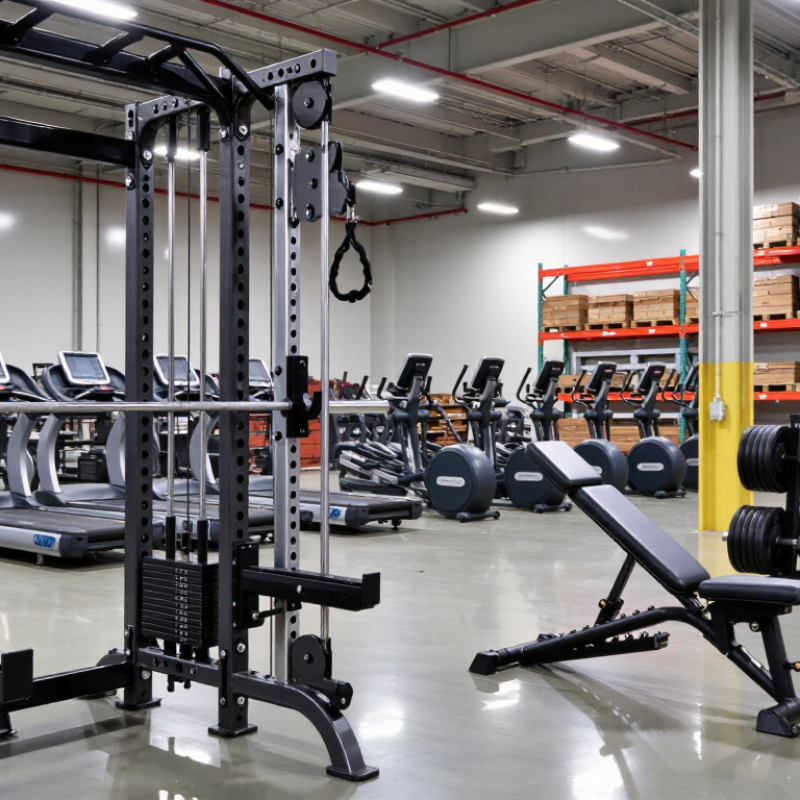
“Heavy-duty” is not a single technical grade. It should describe equipment matched to a clear use class, such as home training, shared fitness rooms, or high-traffic commercial gyms. Each setting brings different demands. A squat rack used by several people daily faces more repeated loading than one used occasionally at home.
Rated capacity also needs a precise definition. For a rack, it may refer to the maximum bar load; for a cable station, it may describe the user’s applied resistance. These figures are not always directly comparable. Check the manual and product label, and ask whether the rating covers moving loads, accessories, and regular use. Details matter.
Look beyond a large number. Inspect welds, frame dimensions, adjustment pins, cable routing, and the stability of the feet on a level floor. Ask for test records and clear maintenance guidance. A capacity rating is useful, but it does not guarantee safe use in every setup. I would also confirm how the manufacturer defines its use class; the terminology can be inconsistent, and that deserves a second look.
A heavy-duty machine can look reassuring on a factory floor, but appearance does not establish its intended use. ISO 20957-1 classifies stationary training equipment by setting: Class H is for home use, Class S is for professional or commercial use, and Class I is for supervised group settings. These are different use categories, not simple rankings of quality.
For buyers comparing Chinese manufacturers, ask which class applies to each model, not just the product range. Request the relevant test documentation and confirm that it covers the exact configuration being ordered. A bench with a different frame, cable route, or adjustment mechanism may need separate assessment. Check the rated user and training loads, stability, moving parts, and warning labels. Details matter. A selector pin should seat cleanly; a cable should move without rubbing against its guard.
ISO 20957-1 provides a useful framework, but a class label alone cannot tell you how equipment will hold up in a busy gym. Ask how the manufacturer controls welding quality, verifies incoming materials, and handles design changes. Factory visits and sample inspections can add evidence, though neither guarantees long-term performance. This part is easy to overlook: documentation should match the delivered machine, not merely a similar model. A careful review takes time, and sometimes the paperwork still leaves questions.
When comparing heavy-duty gym equipment manufacturers in China, treat the stated load rating as a claim to verify, not a performance guarantee. Ask for the test report behind each figure: tested load, cycle count, fixture setup, failure criteria, and calibration details. A “500 kg capacity” label means little without knowing whether it refers to static load, working load, or user weight. Small distinction. Big consequences.
Check steel specifications by component. Request the grade, tube dimensions, wall thickness, and any material certificates for frames, pins, and weldments. ASTM F2276-18(2023) covers design and construction requirements for stationary exercise equipment; ISO 20957-1:2024 sets general safety requirements and test methods. These standards help frame questions, but they do not prove a particular machine passed a specific load test. Prefer dated, model-specific reports from competent test laboratories, with traceable calibration; ISO/IEC 17025:2017 outlines laboratory competence requirements. Some suppliers provide only a certificate page. That is not enough.
Tips: Compare like with like. Ask whether the rating is per side or total, and request photos of the test setup and failure points. Check weld seams around rack uprights and bench pivots; a neat finish is useful, but not a substitute for measured results. If the report omits the test method, ask for clarification before comparing prices.
Minimum yield strength of selected structural steel grades (MPa; nominal thickness ≤16 mm where applicable)
Q235B and Q355B values are for nominal thicknesses up to 16 mm; ASTM A500 Grade B is shown at its specified minimum yield strength. These steel-grade benchmarks do not establish a gym machine’s rated load or verify a manufacturer’s test reports. Confirm equipment capacity and test documentation for each specific product.
ASTM F2276 offers a useful reference when evaluating heavy-duty gym equipment manufacturers in China. It addresses fitness equipment design and performance, including safety-related considerations. Buyers should confirm which edition applies and whether the specific product category falls within its scope.
Look beyond a supplier’s claim of compliance. Request test reports tied to the exact model, plus drawings and load specifications. Check how the bench resists tipping under uneven loading, whether adjustment pins lock securely, and if exposed edges or moving parts create hazards. Small details matter. A thick steel frame can still flex at a poorly designed joint. That sounds obvious, but it is easy to overlook.
Ask how the manufacturer verifies performance during production, not only on a prototype. Review inspection records, material traceability, and the instructions supplied with the equipment. ASTM F2276 is a benchmark, not a blanket certification or a guarantee of long-term durability. A careful buyer should compare documented results with the intended training loads and usage frequency. Some evidence may still leave questions. That is a reason to ask for clarification, not to assume the equipment is unsuitable.
Use this model-neutral checklist to compare suppliers and equipment. ASTM F2276 is a fitness-equipment specification, not a manufacturer ranking or a blanket certification; confirm the applicable edition, clauses, and test scope for each product.
| Equipment category | Design and performance checks | Useful verification evidence | ASTM F2276 assessment | Supplier comparison benchmark |
|---|---|---|---|---|
| Power racks and squat stands | Check frame stability, weld quality, upright and crossmember construction, safety-arm adjustment, and secure anchoring instructions. | Model-specific drawings, rated-load documentation, applicable test reports, assembly instructions, and inspection records. | Review applicable design, construction, stability, and safety provisions for the exact configuration. Do not assume a load rating alone establishes conformity. | Prefer traceable, model-specific evidence and clearly stated installation conditions over unsupported “heavy-duty” claims. |
| Adjustable benches | Inspect base stability, backrest and seat locking mechanisms, adjustment retention, frame joints, and pinch or shear points during movement. | Adjustment-cycle records, applicable load-test results, lock inspection details, user instructions, and maintenance guidance. | Check the relevant safety and structural requirements for the bench design and adjustment features under the applicable edition. | Compare repeatable locking, stability across adjustment positions, and documentation for the precise bench model. |
| Selectorized strength machines | Check cable routing and retention, guards, moving-part clearances, weight-stack movement, selector-pin engagement, and accessible adjustment points. | Cable and component specifications, applicable functional or endurance test reports, inspection procedures, labels, and user instructions. | Assess applicable moving-part, guarding, labeling, and construction provisions; confirm test methods and acceptance criteria against the relevant clauses. | Look for documented inspection of cables, fasteners, guards, and selector engagement—not just a stated maximum user or stack load. |
| Plate-loaded strength machines | Review frame and pivot construction, plate-retention features, handle security, movement path, and stability throughout the intended range of motion. | Engineering drawings, component and weld inspection records, model-specific load-test evidence, and assembly and use instructions. | Determine which general fitness-equipment requirements and product-specific test provisions apply; document any exclusions or configuration limits. | Compare the stated loading method, plate-sleeve details, test configuration, and evidence linking results to the supplied model. |
| Cable crossover and functional trainers | Inspect cable travel, pulley alignment, attachment retention, adjustment locks, guarding, and potential finger or clothing entrapment areas. | Cable and pulley specifications, adjustment and functional test records, maintenance intervals, and model-specific operating instructions. | Verify applicable requirements for moving components, access hazards, and safe operation using the standard edition identified in the test documentation. | Give preference to clearly defined maintenance limits and component-replacement guidance supported by the supplier’s documentation. |
| Indoor stationary cardio equipment | Check stability, accessible moving-part guards, user controls, emergency-stop or stopping features where applicable, and electrical safety documentation for powered models. | Applicable safety and functional test reports, electrical documentation where relevant, operating instructions, and maintenance records. | Confirm that F2276 applies to the equipment and use case; identify any additional product-specific standards or regulatory requirements separately. | Assess complete, model-specific compliance documentation rather than treating one standard reference as proof of every applicable requirement. |
| All equipment categories | Confirm product identification, warnings, user instructions, assembly requirements, inspection intervals, and a process for tracking design or component changes. | Test report identifying the exact model and configuration, report date and test scope, revision-controlled drawings, and a documented quality-control process. | Request the standard edition and clauses used, the test laboratory and scope, and any limitations. A supplier declaration or certificate should be checked against the underlying evidence. | Use a documented pass / fail / not-applicable review for each requirement; record unresolved gaps and confirm corrective actions before purchase. |
Important: ASTM F2276 does not provide a universal manufacturer ranking or a single pass score for all equipment. Confirm the current applicable edition and product-specific requirements with the standard and a qualified testing professional before making a compliance claim.
China’s heavy-duty gym-equipment manufacturers are best mapped by product capability, not by a single ranking. Common specializations include plate-loaded strength machines, power racks and benches, cable systems, and commercial cardio equipment. Grand View Research estimated the global fitness-equipment market at US$16.04 billion in 2022, with a projected 5.3% compound annual growth rate from 2023 to 2030. This signals broad demand, but it does not identify which Chinese factories serve each export market.
Export fit depends on more than the product catalog. Buyers targeting North America or Europe should check load ratings, finish quality, replacement-part availability, and shipment packaging. Ask for test records and inspect welds, pulley movement, and frame stability on sample units. UN Comtrade records under HS 950691 can help compare national trade flows for physical exercise equipment. The code is broad, though; it cannot identify individual manufacturers or reliably separate every product type. The map is not perfectly tidy.
Tips: Match factory specialization to your actual order mix. Request destination-specific references, spare-parts lead times, and container-loading photos. A polished brochure proves little.
It depends on the use class: home training, shared rooms, or busy commercial gyms. Daily use adds more repeated loading.
Check whether it means maximum bar load, working load, or another measure. The manual and product label should clarify.
Not directly. A rack rating and a cable station rating may describe different loads. Small detail. Big difference.
Look for the tested load, cycle count, test setup, failure criteria, and calibration details. Ask for a dated report for the exact model.
Ask for the steel grade, tube dimensions, and wall thickness. Material records for frames, pins, and welded parts can help.
Check weld seams, adjustment pins, cable routing, frame dimensions, and stable feet. A level floor matters, too.
No. Setup, maintenance, and intended use still matter. Follow the manual, and confirm what the rating covers.
Ask for the full test method and setup photos before comparing prices. I may be overchecking, but unclear reports deserve another look.
Choosing the right heavy-duty gym equipment begins with understanding how and where it will be used. ISO 20957-1 distinguishes stationary training equipment by intended use: Class H for home use, Class S for professional or commercial settings, and Class I for supervised use in institutions. Buyers should compare more than advertised maximum loads, reviewing rated capacity, steel specifications, weld quality, stability, and available test reports to assess durability and suitability.
ASTM F2276 provides additional benchmarks for equipment design and performance, helping purchasers evaluate safety-related features and construction. China’s manufacturers serve different needs through specializations such as strength machines, racks, benches, and cardio equipment, with products aimed at domestic, commercial, and export markets. A careful selection process matches product specialization and verified performance evidence to the facility’s use class, training demands, and maintenance requirements.