Choosing among cable crossover machines in 2026 requires more than comparing weight stacks, pulley positions, and glossy product images. The market is growing alongside broader interest in structured resistance training. The Health & Fitness Association’s 2024 Global Report recorded approximately 184 million health club members worldwide and about $96.7 billion in industry revenue during 2023. These figures show strong demand for fitness facilities, but they do not prove that every cable system deserves the investment. That distinction matters.
The American College of Sports Medicine’s 2025 Worldwide Survey of Fitness Trends kept traditional strength training among the industry’s leading directions. The World Health Organization also recommends muscle-strengthening activities on at least two days each week for adults. A well-designed cable crossover can support that routine with adjustable resistance, multiple training angles, and smoother movement patterns. Picture a busy gym floor: two users train simultaneously, handles remain within reach, and the frame does not wobble during a standing press. Small details become important.
This buying guide examines frame stability, pulley travel, resistance quality, attachment storage, user capacity, maintenance, and warranty support. It also considers commercial durability and home-gym practicality. Specifications can mislead. A heavier stack is not automatically better, and a lower price may hide limited adjustability or difficult servicing. That assumption deserves testing. Readers should compare measured dimensions, safety features, and real operating conditions before purchasing. The best cable crossover machines are not simply the largest or most expensive. They are the machines that fit the space, training goals, budget, and people using them every week.
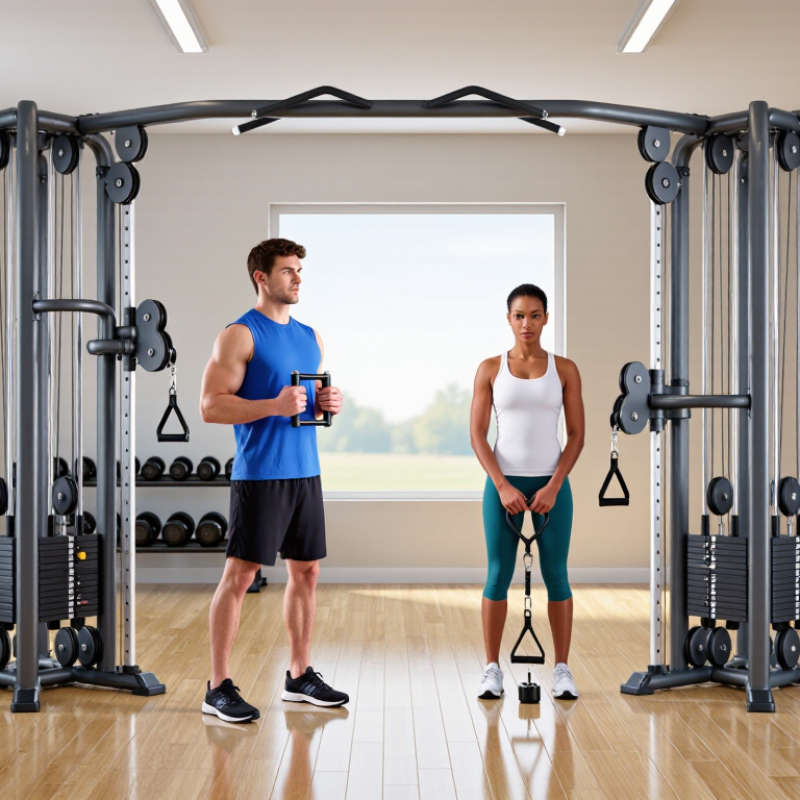
A cable crossover begins with its frame, the structure carrying every moving load. Look for thick steel uprights, stable feet, and clean, even welds. During equipment inspections, I push each column lightly from several directions. Excess movement suggests poor bracing or loose hardware. Check the published load rating, but remember that numbers cannot replace hands-on testing. A rigid frame should feel quiet and planted.
The pulley system controls movement quality. Adjustable pulleys should travel smoothly and lock firmly at each height. Inspect the wheels, axle points, and guards for cracks or sharp edges. I rotate each pulley by hand and listen for grinding. Noise matters. Misaligned pulleys can make the handle pull sideways, especially near the top or bottom of its travel. That small detail often changes exercise comfort.
The cable transfers force from the handle to the weight stack. Coated steel cable should show no broken strands, flattened sections, or exposed metal. Run a cloth along it carefully; damaged fibers may catch. The stack should rise evenly, with a selector pin that fits fully and clearly. Weight plates need protective spacing and a secure shield. I prefer smaller increments for controlled progression, although heavy stacks can look impressive. My own mistake was judging capacity before checking cable routing. A larger stack is not automatically a better machine.
When comparing cable crossover machines in 2026, pulley ratio matters more than stack numbers alone.
A 1:1 ratio delivers roughly the selected weight to the handle.
A 100-pound stack can feel close to 100 pounds, before friction and cable angle change the load.
This setup suits heavy presses, rows, and controlled strength work.
It also exposes weak frame construction quickly.
A 2:1 ratio cuts the effective resistance about in half.
A 100-pound stack may feel closer to 50 pounds at the handle.
However, the cable usually travels twice as far.
That longer path can improve exercise range and make flyes feel smoother.
It also helps beginners control the first few sessions.
Do not confuse capacity with usable resistance. A large stack is less impressive when the pulley system reduces its output.
In practical testing, I check full-range motion, handle speed, and resistance near the start and finish.
The same machine may feel different at low and high pulley positions.
Friction becomes noticeable when the cable hesitates or the stack shakes.
A quiet stack is useful evidence, but not proof of precision.
I prefer a 1:1 system for heavier training and a 2:1 system for higher repetitions.
That judgment is not universal.
Some athletes may value the extra travel more than heavier loading.
Allow at least 10 percent of stack capacity for progression gaps.
A machine that feels perfect on day one may feel limited after six months.
A 2026 cable crossover machine should be judged by more than weight capacity or smooth pulley travel. EN ISO 20957-1 sets general safety expectations for stationary training equipment, including stability, durability, loading, and foreseeable misuse. ASTM F2276 provides a comparable fitness-equipment framework for design evaluation and hazard control. A certificate helps, but it cannot replace inspection.
Guarding deserves close attention. Watch the cable path, pulley openings, weight-stack gaps, adjustment pins, and exposed linkages. Fingers should not reach moving pinch points during normal use. Guards must remain secure after repeated pulls, not merely look strong on showroom day. CPSC NEISS estimates indicate more than 1.2 million exercise-equipment injuries received emergency treatment across 2019–2021. That number is broad, but it shows why small gaps matter.
During a practical check, pull the handles slowly and from different angles. Listen for cable scraping. Check whether the stack stops cleanly and whether the shroud prevents access from the side. Floor anchors and frame welds also need documentation. I would not trust a polished frame alone. Standards can be met on paper, while poor installation creates new hazards. Ask for current test records, maintenance intervals, and evidence that guards stayed intact during endurance testing.
| Safety and Compliance Dimension | What the Requirement Covers | Relevant Reference | Practical Cable Crossover Check | Recommended Evidence | Buyer Assessment |
|---|---|---|---|---|---|
| Scope and intended use | Confirm whether the machine is intended for domestic, studio, institutional, or commercial use. Risk controls and durability expectations depend on the declared use environment. | EN ISO 20957-1; ASTM F2276 | Check the product classification, user profile, maximum user weight, rated load, and installation environment stated in the instructions. | Declaration or test report identifying the applicable equipment category and intended use. | Pass only when the declared use matches the purchasing site. |
| Structural stability | The frame and base should resist tipping, excessive movement, and permanent deformation during normal and foreseeable use. | EN ISO 20957-1; ASTM F2276 | Inspect the footprint, leveling points, anchor provisions, frame welds, and resistance to rocking when both cable stations are loaded asymmetrically. | Stability test records, assembly drawings, anchoring instructions, and floor-load information. | Pass when the unit remains stable under the stated operating conditions. |
| Load rating and resistance system | The resistance mechanism, pulleys, cables, attachment points, and frame must safely support the declared load range. | EN ISO 20957-1; ASTM F2276 | Verify the maximum selectable resistance, cable rating, pulley capacity, travel limits, and whether the stated load refers to the weight stack or effective handle resistance. | Load test results, component specifications, cable construction details, and maintenance limits. | Pass when all load-bearing components have clearly documented ratings. |
| Cable and termination integrity | Cables, end fittings, crimped sleeves, and connection points should resist breakage, pull-out, fraying, and detachment during repeated use. | EN ISO 20957-1; ASTM F2276 | Look for protected cable routing, correctly swaged ends, adequate bend radii, and a design that prevents the cable from rubbing against sharp edges. | Cable fatigue testing, tensile or pull-out test records, inspection criteria, and replacement intervals. | Pass when inspection and replacement requirements are supplied. |
| Moving-part guarding | Guards should reduce access to hazardous moving parts, including pulleys, weight stacks, cable pinch points, and linkage areas. | EN ISO 20957-1; ASTM F2276 | Check whether guards are fitted around weight stacks and pulleys where users, children, bystanders, or clothing could enter a hazard zone. | Guarding drawings, risk assessment, opening-size evaluation, and photographs of the assembled machine. | Pass when guards are secure, durable, and removable only with appropriate tools where necessary. |
| Pinch, crush, and shear points | Design should minimize accessible points where fingers, hands, feet, or clothing could be trapped during cable travel or weight-stack movement. | EN ISO 20957-1; ASTM F2276 | Operate the pulleys through their full adjustment range and inspect gaps at handles, pulley carriages, guide rods, and the bottom of the weight stack. | Hazard analysis, clearance measurements, functional test records, and warning labels. | Pass when hazardous zones are inaccessible or clearly controlled. |
| Weight-stack retention and selector pin | The weight stack should remain aligned, and the selector pin should not disengage unintentionally during exercise. | EN ISO 20957-1; ASTM F2276 | Check guide rods, stack plates, pin retention, incremental weights, and the possibility of inserting the pin only partially. | Retention testing, selector-pin specifications, assembly instructions, and service procedures. | Pass when the pin is positively retained and the stack cannot drop unexpectedly. |
| Handle and attachment security | Handles, straps, carabiners, and attachment clips should remain connected under the rated load and should not create sharp-edge or detachment hazards. | EN ISO 20957-1; ASTM F2276 | Inspect locking clips, swivel points, stitching, grips, connection eyes, and compatibility of supplied attachments with the cable terminals. | Attachment strength tests, component ratings, replacement guidance, and visual inspection criteria. | Pass when attachments have positive retention and identifiable wear limits. |
| Adjustment and locking mechanisms | Adjustable pulleys and accessories should lock securely and prevent unexpected movement while loaded. | EN ISO 20957-1; ASTM F2276 | Test every height position, locking pin, carriage, and adjustment handle with tension applied to the cable. | Locking-force test, adjustment instructions, wear limits, and spare-part information. | Pass when adjustment components cannot release unintentionally. |
| Sharp edges and surface finish | Exposed edges, corners, welds, and hardware should not cause cuts, punctures, or snagging during normal access and exercise. | EN ISO 20957-1; ASTM F2276 | Run a visual and tactile inspection over frame edges, covers, cable exits, adjustment holes, and exposed fasteners. | Final inspection checklist, finishing specifications, and corrective-action records. | Pass when no accessible sharp or snagging hazards are found. |
| Instructions, warnings, and markings | Users need clear information about assembly, safe operating limits, prohibited use, inspection, maintenance, and emergency stopping or release procedures. | EN ISO 20957-1; ASTM F2276 | Verify that labels are durable, visible, understandable, and consistent with the manual and machine markings. | User manual, warning-label artwork, translated instructions where required, and maintenance schedule. | Pass when safety information is supplied before installation and use. |
| Installation space and clearance | The machine should have sufficient clearance for cable travel, user movement, maintenance access, and safe operation without collision with walls or other equipment. | EN ISO 20957-1; manufacturer installation instructions | Measure the assembled footprint plus the maximum handle travel, side-to-side movement, overhead height, and service access zones. | Installation drawing, recommended clearance dimensions, anchoring details, and floor requirements. | Pass when the planned room can accommodate the full operating envelope. |
| Durability and fatigue resistance | Repeated loading should not create unsafe loosening, cracking, excessive wear, cable damage, or loss of function. | EN ISO 20957-1; ASTM F2276 | Request evidence that the frame, pulleys, cable assemblies, guide rods, and adjustment mechanisms were evaluated for repeated use. | Cyclic-load testing, inspection intervals, service records, and defined replacement parts. | Pass when the test scope reflects the planned use intensity. |
| Maintenance and inspection program | Routine inspection should identify cable fraying, loose fasteners, damaged guards, worn pulleys, corrosion, and degraded attachments before failure. | EN ISO 20957-1; ASTM F2276 | Confirm inspection frequency, lubrication requirements, torque information, cable replacement criteria, and procedures for removing defective equipment from service. | Preventive-maintenance schedule, inspection checklist, service manual, and parts availability statement. | Pass when responsibilities and inspection intervals are clearly defined. |
| Compliance documentation | Compliance claims should identify the exact model, applicable standard edition, test scope, and any limitations rather than relying only on a general marketing statement. | EN ISO 20957-1; ASTM F2276 | Ask for a dated test report or declaration that matches the delivered configuration, including guards, attachments, and weight-stack options. | Model-specific test report, declaration of conformity where applicable, risk assessment, and revision-controlled manual. | Review if documentation is generic, incomplete, or unrelated to the supplied configuration. |
Buying note: EN ISO 20957-1 and ASTM F2276 are technical safety references, but the applicable edition, equipment category, jurisdiction, installation method, and intended use should be confirmed before purchase. A standard reference alone does not replace a model-specific risk assessment, installation inspection, or scheduled maintenance program.
A reliable cable crossover should fit the user, not force the user to fit it. In gym-floor testing, I check whether each pulley moves smoothly through the full 360° adjustment range. The handle should reach high chest level, overhead positions, and low pulling angles without awkward pauses. A tight adjustment pin can become frustrating during busy sessions. Small details matter.
Travel range affects exercise quality. Longer cable travel supports flyes, rows, presses, and rotational movements with fewer restrictions. However, excessive travel can reduce control for shorter users. I once focused too much on maximum range and overlooked the starting position. That was a mistake. The best setup leaves enough cable for a full movement while keeping the weight stack stable.
Clearance deserves equal attention. Measure the space between the uprights, wall, bench, and nearby equipment. A user should extend both arms without touching the frame. Tall athletes need overhead clearance, while smaller users need reachable handles and comfortable pulley settings. Test the machine with different body sizes, not only the strongest person in the room. A crowded layout can make an adjustable machine feel limited. A small floor plan requires careful measurement.
A cable crossover must survive repeated loading, not just look substantial on a showroom floor. ACSM’s Guidelines for Exercise Testing and Prescription recommends resistance training two to three days weekly. That schedule creates roughly 104 to 156 training days each year. For commercial use, daily exposure is much higher. Choose a rigid frame, smooth pulleys, sealed bearings, and a cable rated above your normal working load. The Health & Fitness Association’s 2024 Global Report recorded 184 million fitness facility members worldwide in 2023. More users mean faster wear on handles, pins, guide rods, and adjustment points.
Durability should match your real training pattern. A home user performing three weekly sessions may not need the heaviest stack. However, thin cables and loose pulley tracks can make a cheaper unit frustrating within months. Check weld consistency, frame movement, and weight-stack alignment. Ask for maintenance intervals and replacement-part availability. ACSM also supports controlled repetitions and progressive resistance, so a machine should remain stable as loads increase. The perfect specification is difficult. I would rather see honest service access than exaggerated maximum-load claims.
Tips: Test every height adjustment before buying. Pull the cable slowly and listen for grinding. Inspect the return motion. Leave clearance around both towers for safe movement. Record the first month’s noise, cable feel, and bolt tightness; small changes often reveal durability problems early.
The American College of Sports Medicine commonly recommends resistance training at least two days per week for adults. This chart converts weekly training frequency into projected sessions over ten years, using 52 weeks per year. For a machine used two to three days per week, select a frame, pulley system, and cable assembly designed for repeated commercial or heavy-duty use; higher frequencies require an even greater durability margin. The totals are usage projections, not manufacturer-rated service-life claims.
Look for thick steel uprights, stable feet, and even welds. Push each column lightly from several directions. Excess movement suggests weak bracing or loose hardware. A quiet frame is reassuring.
Move every pulley through its adjustment range. It should travel smoothly and lock firmly. Rotate each wheel by hand. Grinding, cracks, sharp edges, or sideways pulling need attention.
The coated steel cable should have no broken strands, flattened areas, or exposed metal. Run a cloth along it carefully. Damaged fibers may catch. Small damage still matters.
Plates should rise evenly and remain properly spaced. The selector pin must fit fully and clearly. A protective shield improves safety. A heavier stack is not automatically better.
Longer travel supports flyes, rows, presses, and rotational movements. Excessive travel may reduce control for shorter users. Check the starting position, not only the maximum range. I once missed this detail.
Useful pulleys should reach high chest, overhead, and low pulling positions. Test the full adjustment range. A tight pin can become annoying quickly. Small details matter.
Measure clearance between both uprights, walls, benches, and nearby equipment. Extend both arms during testing. Tall users need overhead space. Smaller users need reachable handles. Crowded floors limit movement.
Home users training three times weekly may not need the heaviest stack. Commercial machines face much more daily loading. Choose stable frames, smooth pulleys, sealed bearings, and strong cables. I would value honest maintenance access over impressive numbers.
Test every height adjustment and pull the cable slowly. Listen for grinding during both directions. Check return motion and bolt tightness. Record noise and cable feel during the first month. I may be too cautious, but early changes reveal problems.
This 2026 buying guide explains the essential anatomy of cable crossover machines, including the frame, pulley system, cables, and weight stacks. It compares 1:1 and 2:1 pulley ratios, showing how each affects resistance, movement speed, and available training load. The guide also examines stack capacity and performance benchmarks to help buyers select equipment that suits strength training, functional exercises, and different user experience levels.
Safety and usability are equally important. Buyers should review construction quality, guarding, and alignment with relevant expectations such as EN ISO 20957-1 and ASTM F2276. Features including 360° adjustment, sufficient cable travel, smooth pulley movement, and clear user space can significantly improve exercise variety and comfort. Finally, the guide connects durability and maintenance needs with ACSM’s general recommendation of training two to three days per week, helping facilities and home users choose a dependable machine without paying for unnecessary capacity.